
Sweeping Folklore
- You’ll never marry if someone sweeps under your feet. (I heard this one all the time when I was a teenager.)
- Never sweep twice in the same place. (You’d have to be a much better sweeper than me to pull this one off!)
- It’s bad luck to sweep trash out the door. (I think it’s bad luck because then you’d have to clean the yard!)
- Never sweep after dark. (Sounds good to me.)
- Never step over a broom…unless of course you’re jumping it to get married.
And that concludes my Appalachian advice on sweeping for today.
Tipper

Tipper
I think I must have done them all since I am still not married. I have heard most of those sayings all my life maybe I should have spent more time paying closer attention to what was being said. ‘YOU THINK” LOL
HAVE A GREAT DAY
DEB
Love this. The only one I’ve ever heard is “do not sweep under someones feet (or vacuum, mop)” or they’ll never marry.
I HAVE sweap a few things under the rug, .. metaphorically of course.
Again, thank heaven for electricity and vacuums.
TIPPER: I WISH YOU ALL THE BEST OF WEATHER FOR THE PERFORMANCE IN HELEN! WISH WE COULD MAKE IT!
You probably read about my brother’s (Donald) death. Everyday I think about him! It is too sad to remember what a dear brother he was!!!
Eva Nell
What about the time the Deer Hunter ( swept ) ya off your feet ?
My mother never had a dust pan. She swept the dirt out the door. That was because 6 kids were tracking it in as fast as she could sweep it back out. She just put it back where it came from. They call it erosion mitigation nowdays.
Yes, I said nowdays not nowadays. That extra a in the middle don’t do nothing noway.
Tipper,
When I was a kid, we use to sweep our yard. Everybody did this, and mama wanted our yard to be slick as a frog’s belly. We had no grass to mow anyway, but the chickens sure had a nice place to eat.
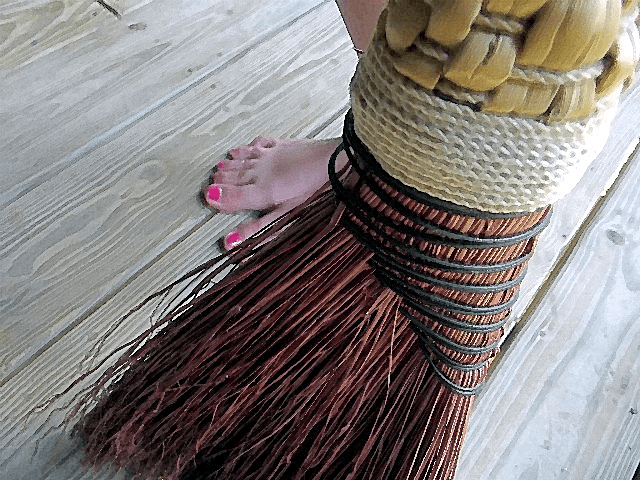
That sure is a pretty broom in the picture. …Ken
Tipper – I attended a small country church when I lived in Tennessee many years ago. One day while some of us stayed behind after a meal to finish cleaning up the fellowship hall, the man sweeping got his little pile to the door and looked around as if trying to spot a dust pan. A little boy of about 6 was standing nearby and, without a hitch, lifted up the corner of the door mat and said matter-of-factly, “Here, sweep it under the rug!” Of course, we couldn’t help but giggle at that one.
Seems like there should have been one about sweeping the yard. But I never heard one, even though Grandma kept her yard swept.
I always heard that ‘broomsage’ was used to make brooms but I never saw one made out of it.
So what is the connection between not sweeping under anyone’s feet and being swept off one’s feet? Seems there ought to be one.
My grandma used to say keeping a broom by the door kept ghosts and spirits out of the house. I’ve also heard that if you tell the broom your troubles while you sweep, it’ll sweep them away by the time you’re done.
Kim and I just got back from a short trip to Berea, Kentucky. We bought my Dad a nice, hand made broom for his shop and my Mom a hand made cobweb sweeper. They were made by the students in the traditional way.
Timely blog this morning.
Tipper,
I’ve heard most of these…except not sweeping after dark…overall I think you have made a
“clean sweep” of sweeping advice today…
I might think of others later….
Thanks Tipper,
Sweeping was a very contentious think to do in my house growing up. My mother forbade sweeping saying “it just moves the dirt around” and “it just stirs up dust” and she did not like dust!
We sure have lots of sayings in Appalachia and some of them make no sense as all like ‘never sweep twice in the same place”, what possible difference could it make except to get the floor cleaner.